

TRAP · Illustrated foundations
Keep the rule
beside the picture.
Read the complete series for Rules 1–5, with expandable rule text and links to the official source.
Rule text and illustrations shared with OurObjection. Source edition: February 6, 2026.
← Back to the appeal guideRule 1. Scope Of Rule; Local Rules Of Courts Of Appeals
1 poster. Read the official rule ↗
Read assigned text for Rule 1 poster 1
Assigned rule text
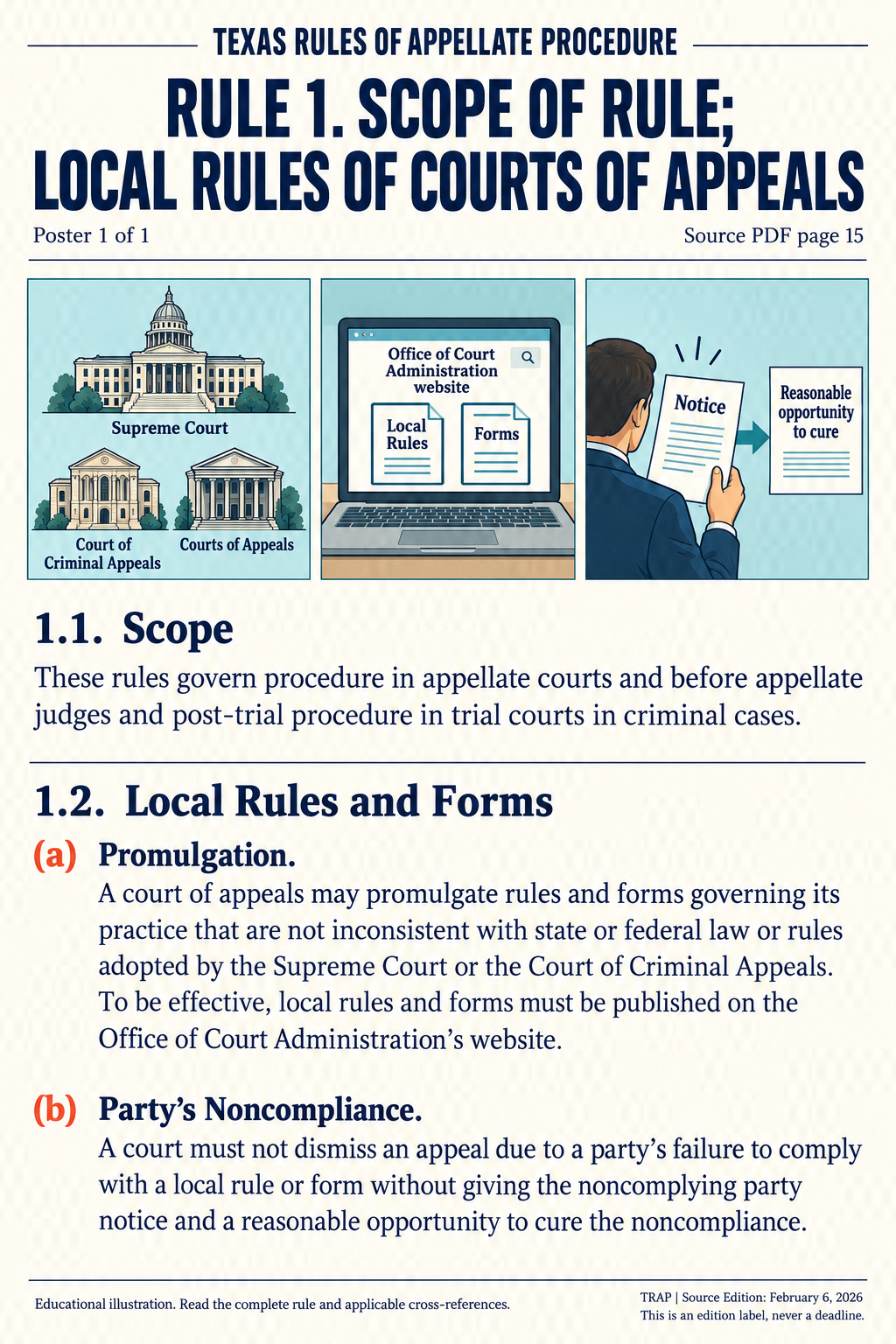
1.1. Scope These rules govern procedure in appellate courts and before appellate judges and post-trial procedure in trial courts in criminal cases.
1.2. Local Rules and Forms
(a) Promulgation. A court of appeals may promulgate rules and forms governing its practice that are not inconsistent with state or federal law or rules adopted by the Supreme Court or the Court of Criminal Appeals. To be effective, local rules and forms must be published on the Office of Court Administration’s website.
(b) Party’s Noncompliance. A court must not dismiss an appeal due to a party’s failure to comply with a local rule or form without giving the noncomplying party notice and a reasonable opportunity to cure the noncompliance.
Rule 2. Suspension Of Rule
1 poster. Read the official rule ↗
Read assigned text for Rule 2 poster 1
Assigned rule text
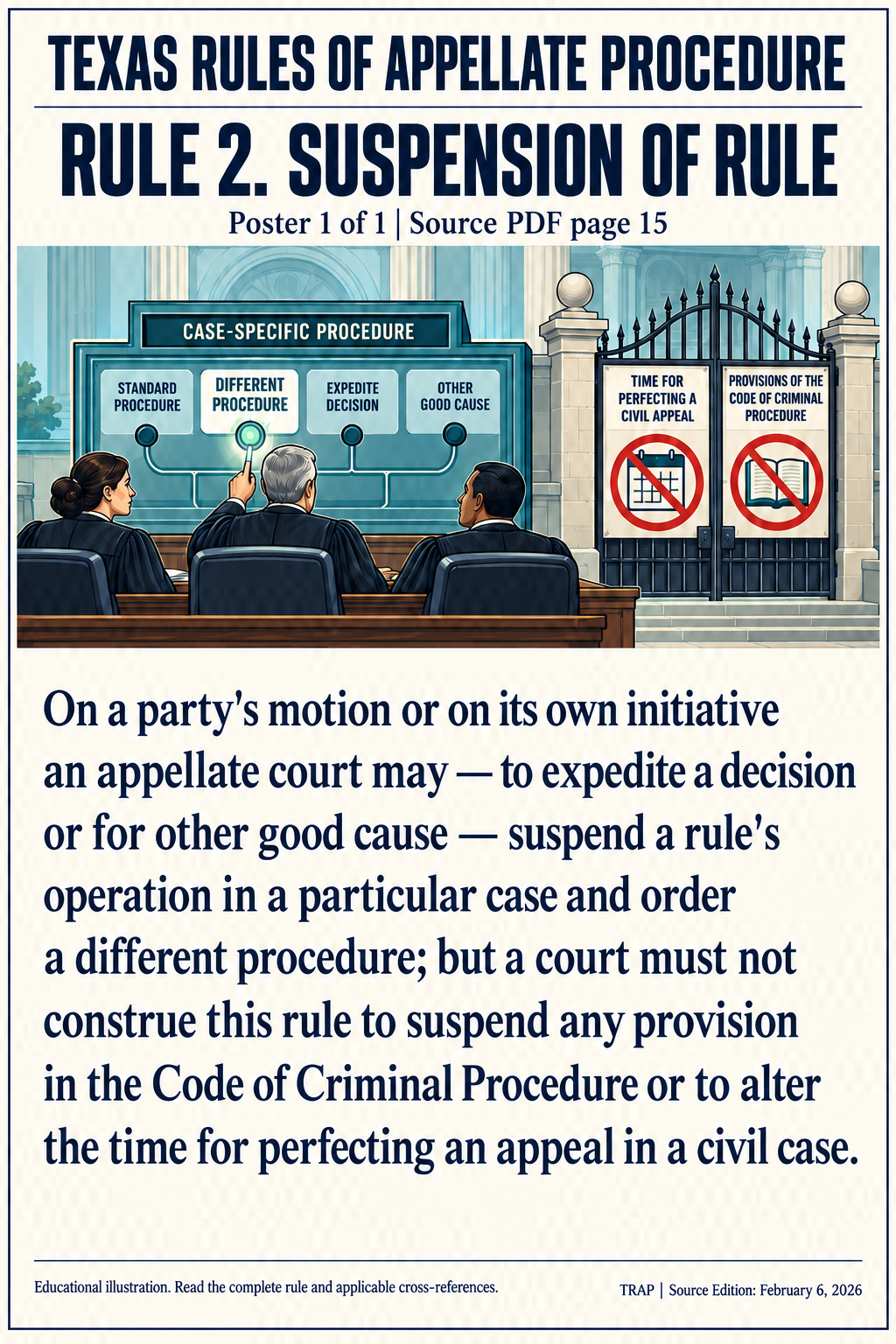
On a party's motion or on its own initiative an appellate court may — to expedite a decision or for other good cause — suspend a rule's operation in a particular case and order a different procedure; but a court must not construe this rule to suspend any provision in the Code of Criminal Procedure or to alter the time for perfecting an appeal in a civil case.
Rule 3. Definitions; Uniform Terminology
1 poster. Read the official rule ↗
Read assigned text for Rule 3 poster 1
Assigned rule text
3.1. Definitions
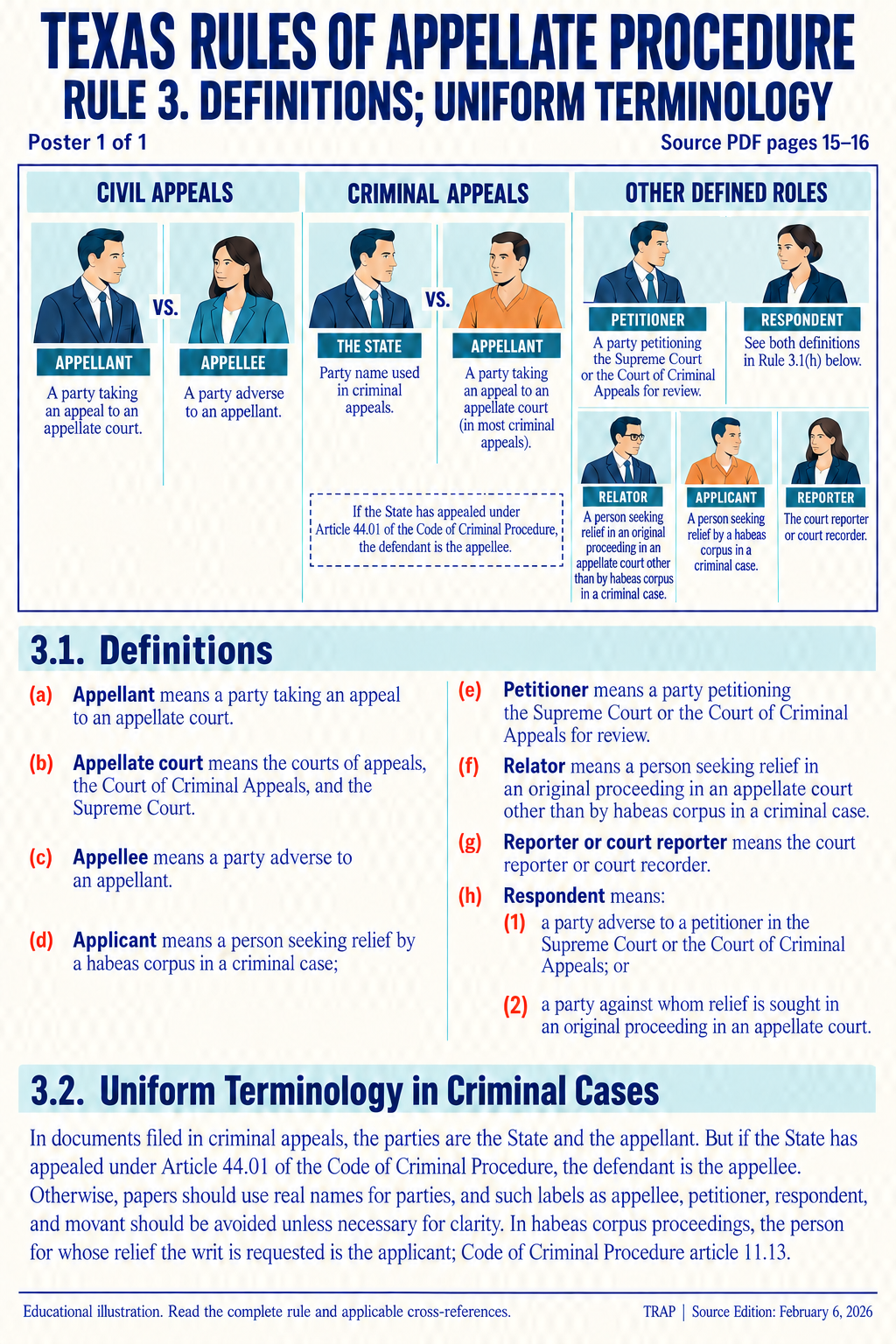
(a) Appellant means a party taking an appeal to an appellate court.
(b) Appellate court means the courts of appeals, the Court of Criminal Appeals, and the Supreme Court.
(c) Appellee means a party adverse to an appellant.
(d) Applicant means a person seeking relief by a habeas corpus in a criminal case;
(e) Petitioner means a party petitioning the Supreme Court or the Court of Criminal Appeals for review.
(f) Relator means a person seeking relief in an original proceeding in an appellate court other than by habeas corpus in a criminal case.
(g) Reporter or court reporter means the court reporter or court recorder.
(h) Respondent means:
(1) a party adverse to a petitioner in the Supreme Court or the Court of Criminal Appeals; or
(2) a party against whom relief is sought in an original proceeding in an appellate court.
3.2. Uniform Terminology in Criminal Cases In documents filed in criminal appeals, the parties are the State and the appellant. But if the State has appealed under Article 44.01 of the Code of Criminal Procedure, the defendant is the appellee. Otherwise, papers should use real names for parties, and such labels as appellee, petitioner, respondent, and movant should be avoided unless necessary for clarity. In habeas corpus proceedings, the person for whose relief the writ is requested is the applicant; Code of Criminal Procedure article 11.13.
Rule 4. Time And Notice Provisions
6 posters. Read the official rule ↗
View all six Rule 4 posters and source text
Read assigned text for Rule 4 poster 1
Assigned rule text
4.1. Computing Time
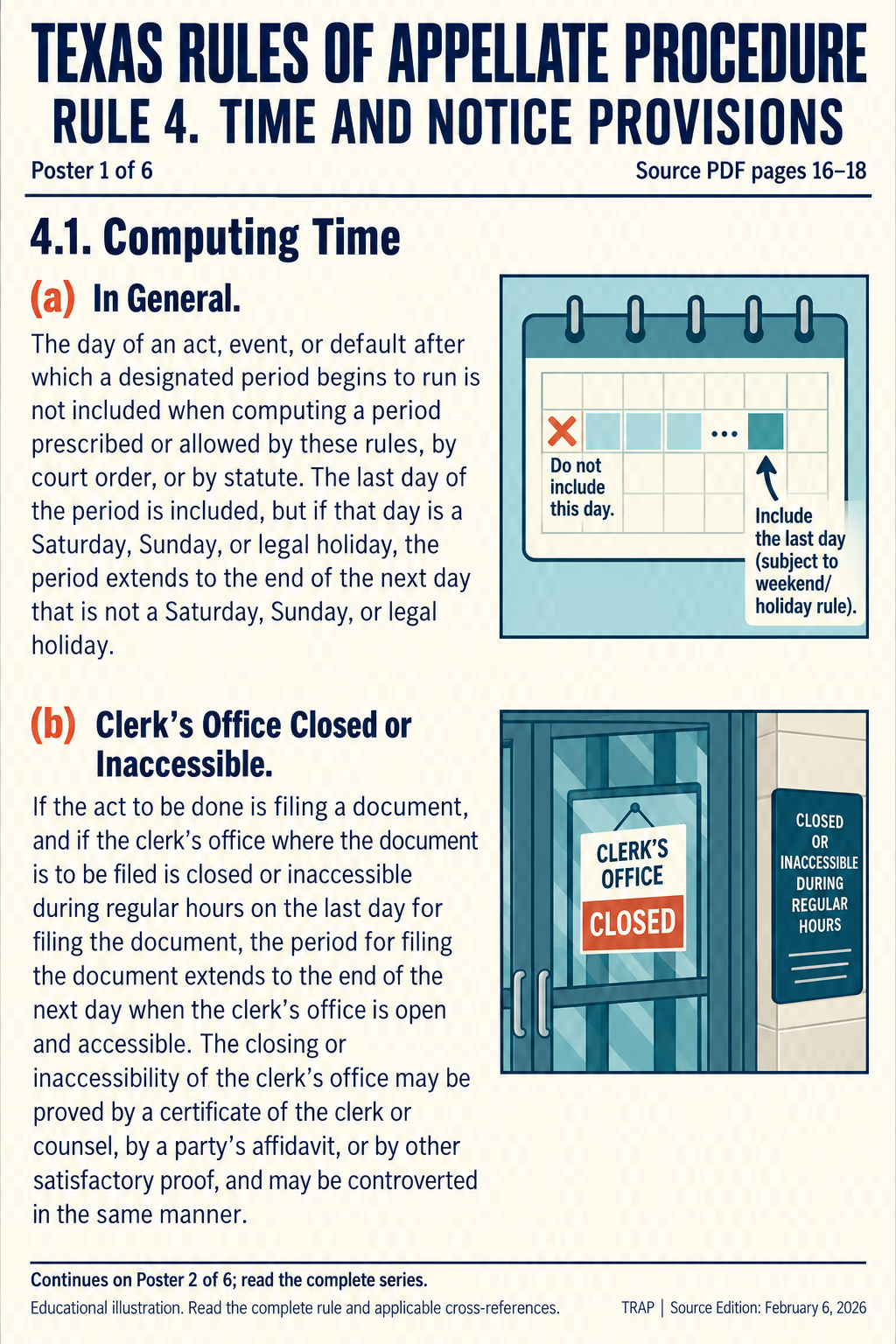
(a) In General. The day of an act, event, or default after which a designated period begins to run is not included when computing a period prescribed or allowed by these rules, by court order, or by statute. The last day of the period is included, but if that day is a Saturday, Sunday, or legal holiday, the period extends to the end of the next day that is not a Saturday, Sunday, or legal holiday.
(b) Clerk's Office Closed or Inaccessible. If the act to be done is filing a document, and if the clerk's office where the document is to be filed is closed or inaccessible during regular hours on the last day for filing the document, the period for filing the document extends to the end of the next day when the clerk's office is open and accessible. The closing or inaccessibility of the clerk's office may be proved by a certificate of the clerk or counsel, by a party's affidavit, or by other satisfactory proof, and may be controverted in the same manner.
Continues on Poster 2 of 6; read the complete series.
Read assigned text for Rule 4 poster 2
Assigned rule text
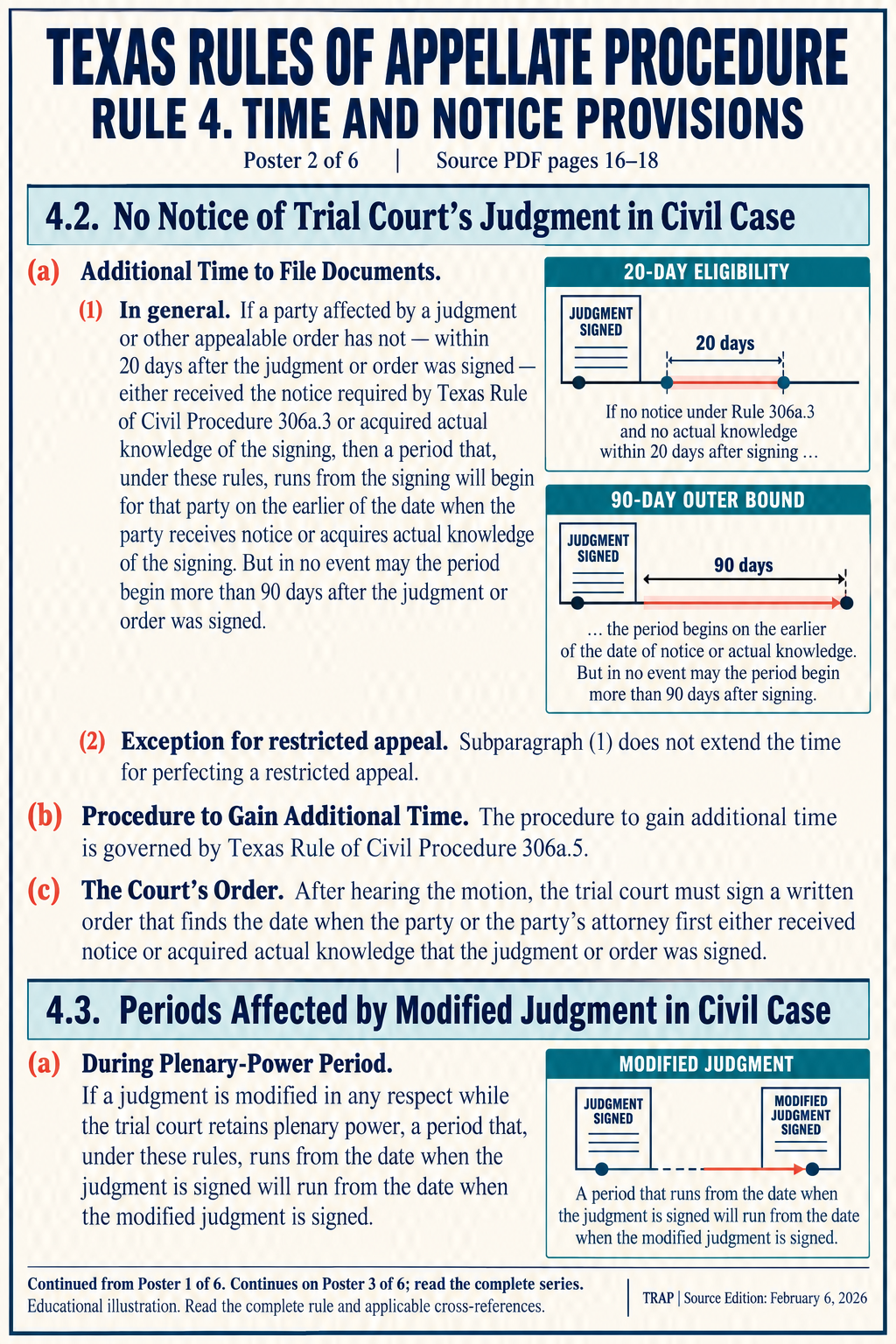
4.2. No Notice of Trial Court’s Judgment in Civil Case
(a) Additional Time to File Documents.
(1) In general. If a party affected by a judgment or other appealable order has not — within 20 days after the judgment or order was signed — either received the notice required by Texas Rule of Civil Procedure 306a.3 or acquired actual knowledge of the signing, then a period that, under these rules, runs from the signing will begin for that party on the earlier of the date when the party receives notice or acquires actual knowledge of the signing. But in no event may the period begin more than 90 days after the judgment or order was signed.
(2) Exception for restricted appeal. Subparagraph (1) does not extend the time for perfecting a restricted appeal.
(b) Procedure to Gain Additional Time. The procedure to gain additional time is governed by Texas Rule of Civil Procedure 306a.5.
(c) The Court’s Order. After hearing the motion, the trial court must sign a written order that finds the date when the party or the party’s attorney first either received notice or acquired actual knowledge that the judgment or order was signed.
4.3. Periods Affected by Modified Judgment in Civil Case
(a) During Plenary-Power Period. If a judgment is modified in any respect while the trial court retains plenary power, a period that, under these rules, runs from the date when the judgment is signed will run from the date when the modified judgment is signed.
Continued from Poster 1 of 6. Continues on Poster 3 of 6; read the complete series.
Read assigned text for Rule 4 poster 3
Assigned rule text
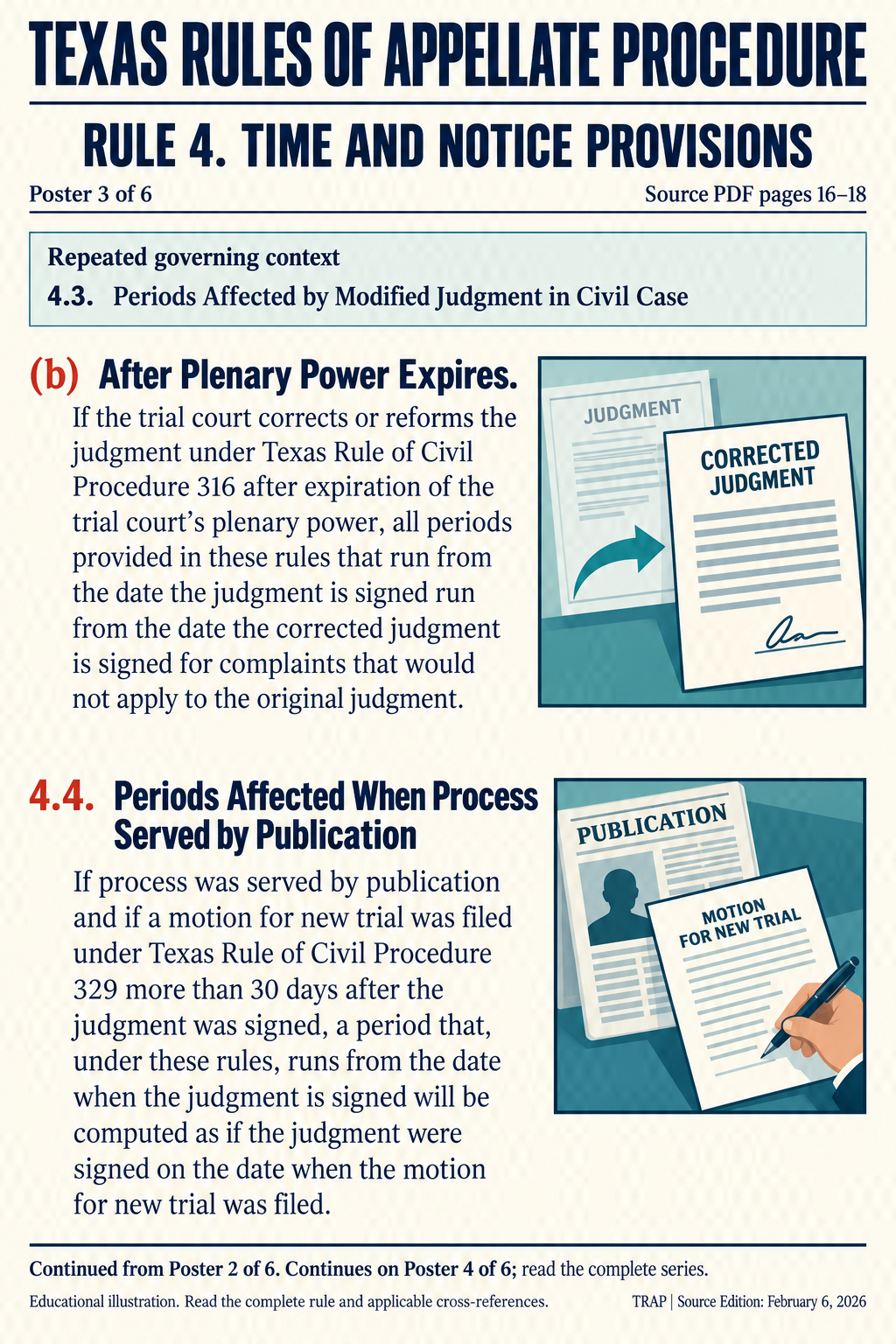
(b) After Plenary Power Expires. If the trial court corrects or reforms the judgment under Texas Rule of Civil Procedure 316 after expiration of the trial court’s plenary power, all periods provided in these rules that run from the date the judgment is signed run from the date the corrected judgment is signed for complaints that would not apply to the original judgment.
4.4. Periods Affected When Process Served by Publication If process was served by publication and if a motion for new trial was filed under Texas Rule of Civil Procedure 329 more than 30 days after the judgment was signed, a period that, under these rules, runs from the date when the judgment is signed will be computed as if the judgment were signed on the date when the motion for new trial was filed.
Repeated governing context
4.3. Periods Affected by Modified Judgment in Civil Case
Continued from Poster 2 of 6. Continues on Poster 4 of 6; read the complete series.
Read assigned text for Rule 4 poster 4
Assigned rule text
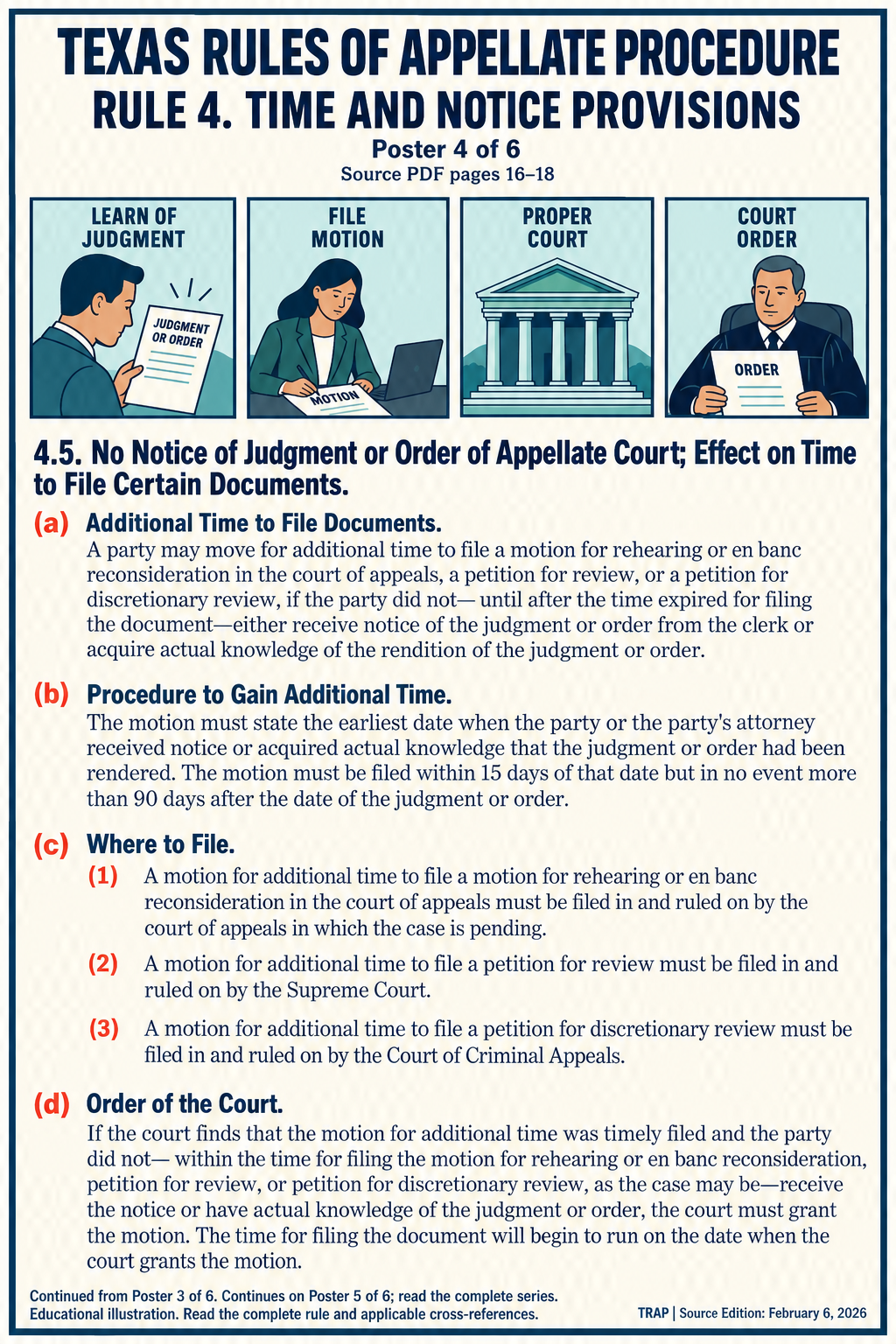
4.5. No Notice of Judgment or Order of Appellate Court; Effect on Time to File Certain Documents.
(a) Additional Time to File Documents. A party may move for additional time to file a motion for rehearing or en banc reconsideration in the court of appeals, a petition for review, or a petition for discretionary review, if the party did not— until after the time expired for filing the document—either receive notice of the judgment or order from the clerk or acquire actual knowledge of the rendition of the judgment or order.
(b) Procedure to Gain Additional Time. The motion must state the earliest date when the party or the party's attorney received notice or acquired actual knowledge that the judgment or order had been rendered. The motion must be filed within 15 days of that date but in no event more than 90 days after the date of the judgment or order.
(c) Where to File.
(1) A motion for additional time to file a motion for rehearing or en banc reconsideration in the court of appeals must be filed in and ruled on by the court of appeals in which the case is pending.
(2) A motion for additional time to file a petition for review must be filed in and ruled on by the Supreme Court.
(3) A motion for additional time to file a petition for discretionary review must be filed in and ruled on by the Court of Criminal Appeals.
(d) Order of the Court. If the court finds that the motion for additional time was timely filed and the party did not— within the time for filing the motion for rehearing or en banc reconsideration, petition for review, or petition for discretionary review, as the case may be—receive the notice or have actual knowledge of the judgment or order, the court must grant the motion. The time for filing the document will begin to run on the date when the court grants the motion.
Continued from Poster 3 of 6. Continues on Poster 5 of 6; read the complete series.
Read assigned text for Rule 4 poster 5
Assigned rule text
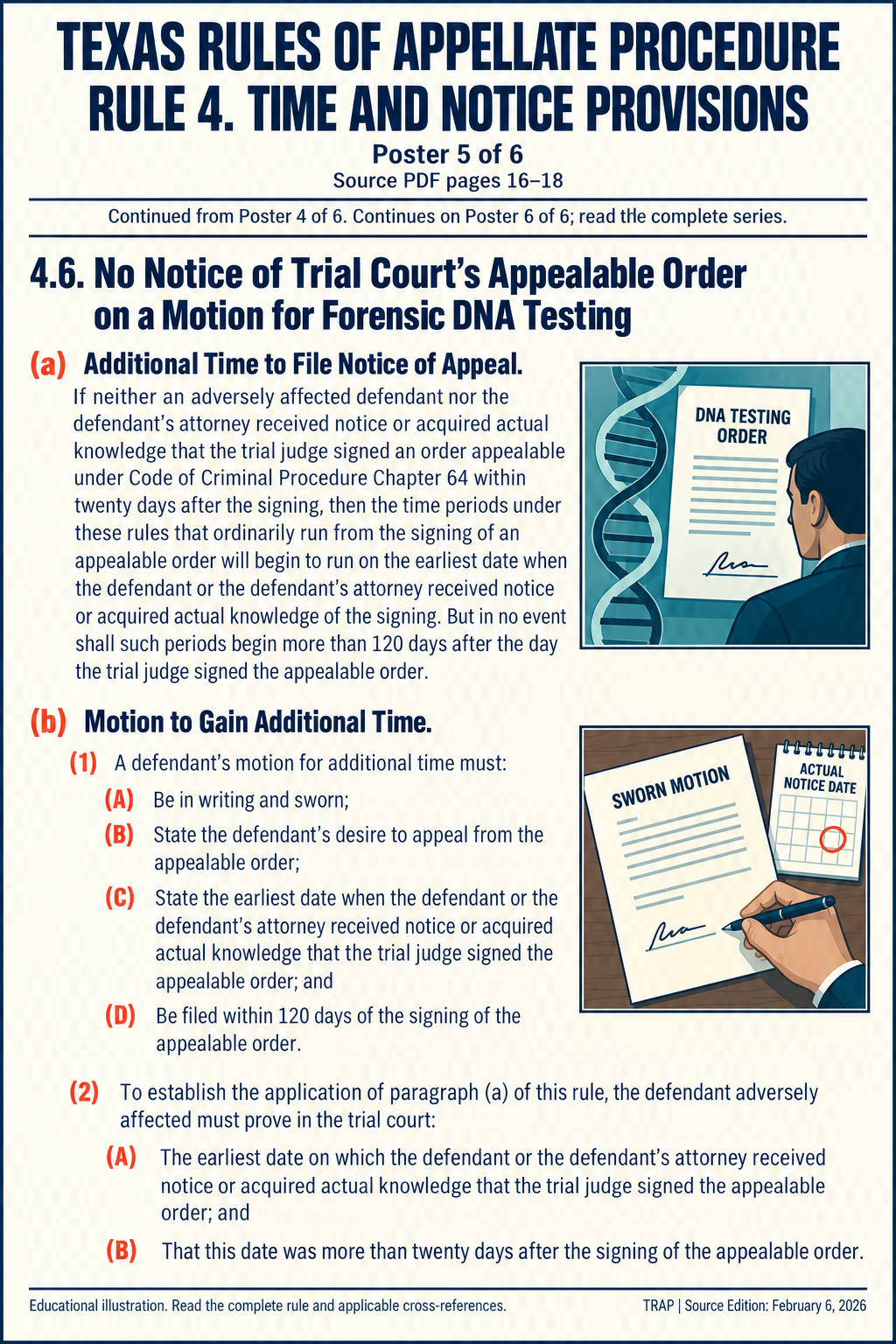
4.6. No Notice of Trial Court’s Appealable Order on a Motion for Forensic DNA Testing
(a) Additional Time to File Notice of Appeal. If neither an adversely affected defendant nor the defendant’s attorney received notice or acquired actual knowledge that the trial judge signed an order appealable under Code of Criminal Procedure Chapter 64 within twenty days after the signing, then the time periods under these rules that ordinarily run from the signing of an appealable order will begin to run on the earliest date when the defendant or the defendant’s attorney received notice or acquired actual knowledge of the signing. But in no event shall such periods begin more than 120 days after the day the trial judge signed the appealable order.
(b) Motion to Gain Additional Time.
(1) A defendant’s motion for additional time must:
(A) Be in writing and sworn;
(B) State the defendant’s desire to appeal from the appealable order;
(C) State the earliest date when the defendant or the defendant’s attorney received notice or acquired actual knowledge that the trial judge signed the appealable order; and
(D) Be filed within 120 days of the signing of the appealable order.
(2) To establish the application of paragraph (a) of this rule, the defendant adversely affected must prove in the trial court:
(A) The earliest date on which the defendant or the defendant’s attorney received notice or acquired actual knowledge that the trial judge signed the appealable order; and
(B) That this date was more than twenty days after the signing of the appealable order.
Continued from Poster 4 of 6. Continues on Poster 6 of 6; read the complete series.
Read assigned text for Rule 4 poster 6
Assigned rule text
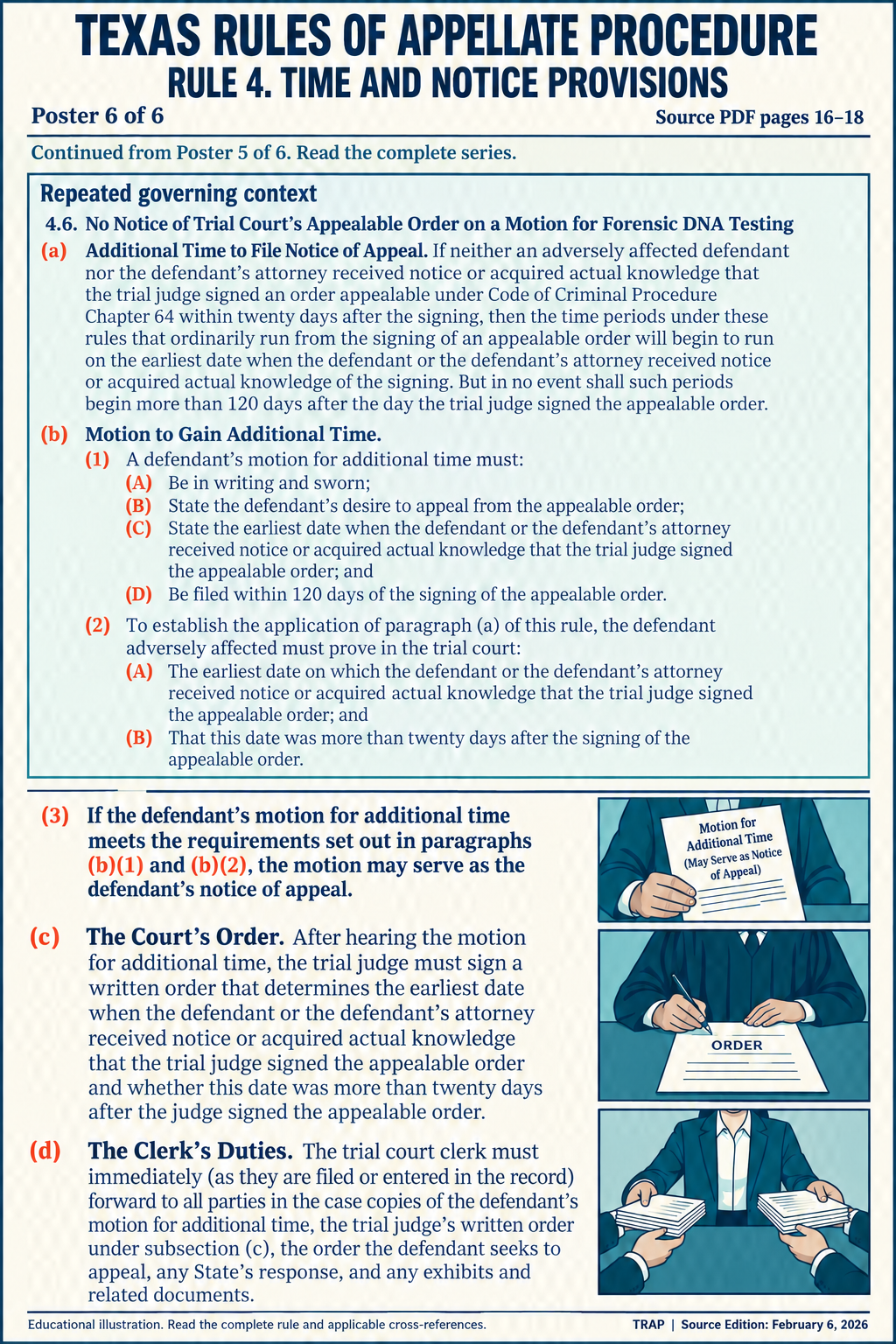
(3) If the defendant’s motion for additional time meets the requirements set out in paragraphs (b)(1) and (b)(2), the motion may serve as the defendant’s notice of appeal.
(c) The Court’s Order. After hearing the motion for additional time, the trial judge must sign a written order that determines the earliest date when the defendant or the defendant’s attorney received notice or acquired actual knowledge that the trial judge signed the appealable order and whether this date was more than twenty days after the judge signed the appealable order.
(d) The Clerk’s Duties. The trial court clerk must immediately (as they are filed or entered in the record) forward to all parties in the case copies of the defendant’s motion for additional time, the trial judge’s written order under subsection (c), the order the defendant seeks to appeal, any State’s response, and any exhibits and related documents.
Repeated governing context
4.6. No Notice of Trial Court’s Appealable Order on a Motion for Forensic DNA Testing
(a) Additional Time to File Notice of Appeal. If neither an adversely affected defendant nor the defendant’s attorney received notice or acquired actual knowledge that the trial judge signed an order appealable under Code of Criminal Procedure Chapter 64 within twenty days after the signing, then the time periods under these rules that ordinarily run from the signing of an appealable order will begin to run on the earliest date when the defendant or the defendant’s attorney received notice or acquired actual knowledge of the signing. But in no event shall such periods begin more than 120 days after the day the trial judge signed the appealable order.
(b) Motion to Gain Additional Time.
(1) A defendant’s motion for additional time must:
(A) Be in writing and sworn;
(B) State the defendant’s desire to appeal from the appealable order;
(C) State the earliest date when the defendant or the defendant’s attorney received notice or acquired actual knowledge that the trial judge signed the appealable order; and
(D) Be filed within 120 days of the signing of the appealable order.
(2) To establish the application of paragraph (a) of this rule, the defendant adversely affected must prove in the trial court:
(A) The earliest date on which the defendant or the defendant’s attorney received notice or acquired actual knowledge that the trial judge signed the appealable order; and
(B) That this date was more than twenty days after the signing of the appealable order.
Continued from Poster 5 of 6. Read the complete series.
Rule 5. Fees In Civil Cases
1 poster. Read the official rule ↗
Read assigned text for Rule 5 poster 1
Assigned rule text
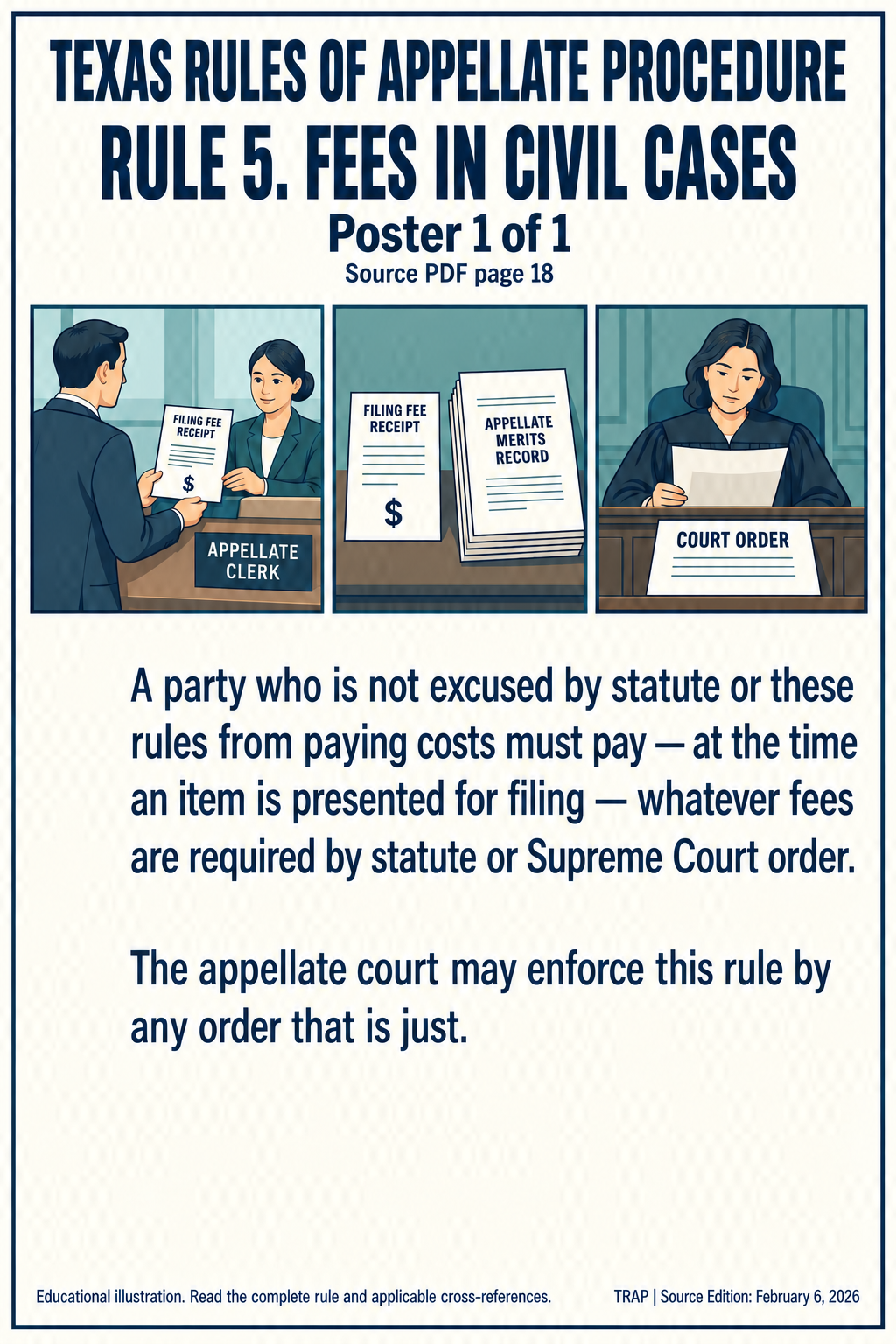
A party who is not excused by statute or these rules from paying costs must pay — at the time an item is presented for filing — whatever fees are required by statute or Supreme Court order. The appellate court may enforce this rule by any order that is just.